Ontario Master’s Immigration Planning
The old Master’s Graduate route is closed — but Ontario graduates still have options
Ontario remains a strong destination for graduate education, but students should no longer choose a Master’s program on the assumption that the degree itself creates a no-job-offer provincial nomination pathway. The strategy now needs to connect education, PGWP eligibility, employment, language ability and the immigration programs available when you are ready to apply.
Book an Appointment
Explore Study Programs
Current Ontario Master’s PR Snapshot
Former OINP Master’s Graduate Stream
Closed on May 30, 2026 as part of Ontario’s OINP redesign.
Current Provincial Option
The new Ontario Workforce Priority Stream is now the province’s active OINP pathway and is primarily employment-driven.
Federal Options Still Matter
Eligible graduates may also build toward Express Entry, the Canadian Experience Class or other federal/provincial pathways based on their actual profile.
What Changed for Ontario Master’s Graduates?
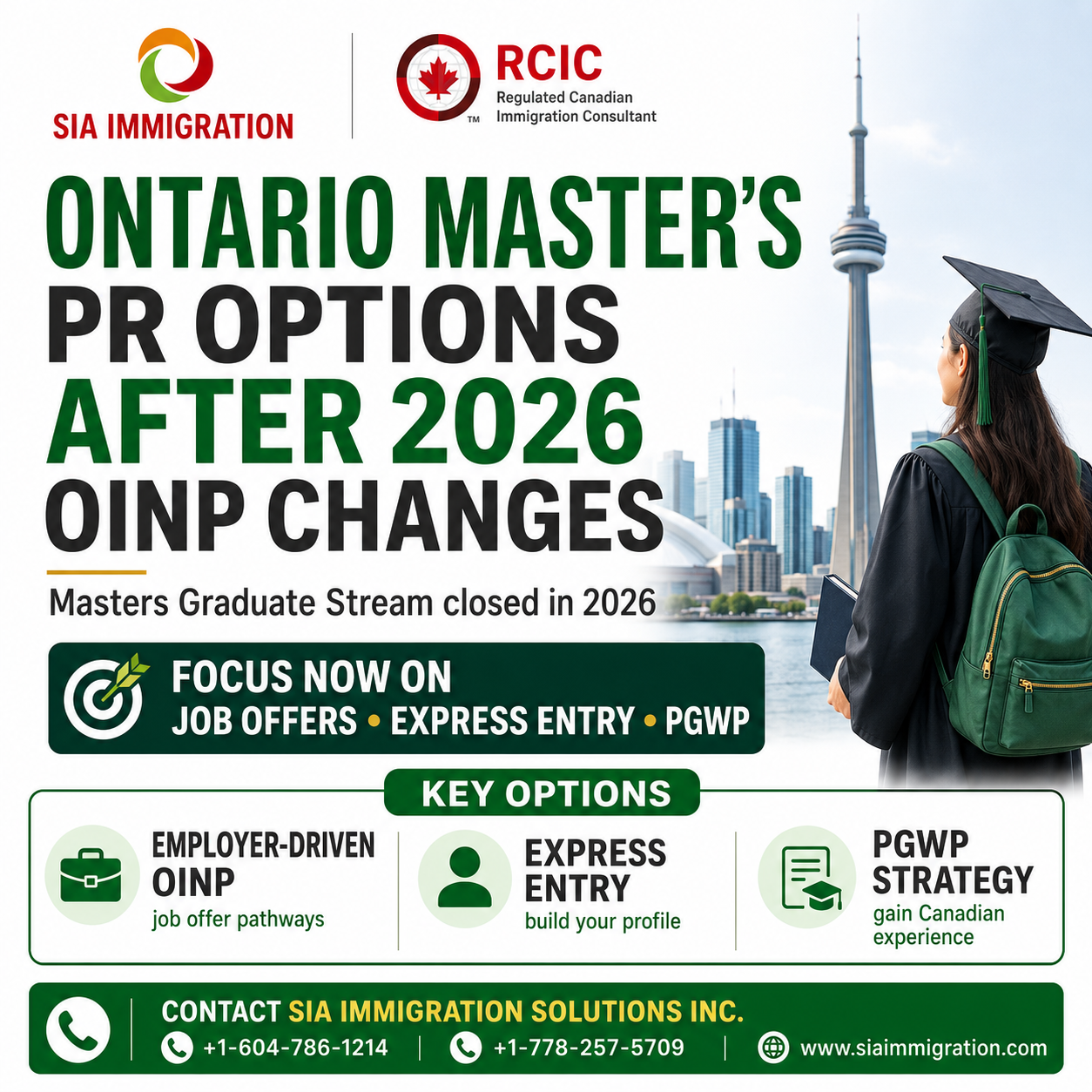
Ontario’s former OINP Master’s Graduate Stream allowed certain eligible Ontario Master’s graduates to pursue provincial nomination without a job offer. Ontario closed that stream on May 30, 2026 as part of a broader redesign of the Ontario Immigrant Nominee Program.
Ontario later replaced its former stream structure with the new Ontario Workforce Priority Stream. This means the provincial strategy for most graduates has shifted away from “complete the degree and apply” toward an employment-based pathway.
Do not rely on older Ontario Master’s PR information
Articles or videos saying “complete an Ontario Master’s and apply for OINP without a job offer” refer to the former stream. That pathway is no longer available for new applicants.
Ontario Workforce Priority Stream
Ontario’s current Workforce Priority Stream provides pathways for qualifying foreign workers with permanent, full-time Ontario job offers across NOC TEER categories. Self-employed physicians have a separate route under the same stream.
TEER 0–3 Pathway
Skilled employment in Ontario
Applicants generally need a qualifying permanent, full-time job offer, approved employer/employment position, required education and language ability, and one of the permitted work-experience routes.
Recent Ontario Graduate Advantage
Reduced work-experience route may apply
Under the current TEER 0–3 rules, a qualifying recent Ontario graduate may meet the work-experience requirement with at least 3 months of consecutive paid full-time experience in the job-offer position with the job-offer employer during the previous 12 months, subject to all other stream requirements.
Important
A Master’s degree alone is not enough
Education is only one part of eligibility. The candidate and employer must satisfy the complete OINP requirements that apply to the pathway and invitation.
Why an Ontario Master’s Can Still Be Valuable
The provincial no-job-offer graduate stream is gone, but a properly selected Master’s degree can still support a broader Canadian career and immigration strategy.
1. Canadian graduate education
A relevant Master’s can provide advanced Canadian credentials, specialized skills, professional networks and access to employers.
2. Potential 3-year PGWP
Under current federal rules, graduates of an eligible Master’s degree program may qualify for a 3-year PGWP even when the Master’s program is less than 2 years, provided it is at least 8 months long and all other PGWP requirements are met.
3. Canadian skilled work experience
An eligible PGWP can provide time to build Canadian employment that may support Express Entry, the Canadian Experience Class or an employment-driven provincial pathway.
4. Express Entry profile
Canadian education, qualifying skilled work experience and strong English or French results can contribute to a broader federal permanent residence strategy. Eligibility and CRS competitiveness must be assessed individually.
Spousal Open Work Permit: Program Length Matters
Students should not assume that every Master’s program makes a spouse eligible for an open work permit.
Current federal rule
Spouses or common-law partners of international students may qualify for a family open work permit when the student is enrolled in a Master’s program that is 16 months or longer, a doctoral program, or another specifically eligible professional program, subject to the current IRCC requirements.
How to Choose the Right Ontario Master’s Program
The best program is not necessarily the program with the strongest immigration marketing. Review the complete education-to-employment pathway before paying tuition.
Academic fit
Does the program logically build on your previous education and professional history?
PGWP eligibility
Confirm the specific institution and program meet current federal PGWP requirements before enrolling.
Program duration
If a spousal open work permit is important to your family plan, confirm that the program length meets the current spouse eligibility rule.
Employment outcomes
Identify realistic occupations after graduation, their NOC/TEER classification and the employers that typically hire for those roles.
Long-term PR strategy
Consider OINP, Express Entry, language improvement, Canadian work experience and other available pathways as a complete plan rather than relying on one program.
A Better Master’s-to-PR Planning Model
Think of the strategy in five separate stages:
STAGE 1
Choose the right Master’s degree
Select a legitimate program that fits your academic background, career direction, budget, PGWP plan and family strategy.
STAGE 2
Complete the program successfully
Maintain valid status, meet the academic requirements and keep your immigration and study records compliant.
STAGE 3
Apply for eligible post-graduation work authorization
Where eligible, apply for a PGWP or another applicable work authorization under the federal rules in force at that time.
STAGE 4
Build qualifying Canadian employment
Seek employment that aligns with your education and can support the experience requirements of the immigration pathways you may later pursue.
STAGE 5
Evaluate the PR options available at that time
Review the Ontario Workforce Priority Stream, Express Entry, Canadian Experience Class and any other federal or provincial pathways for which your profile may qualify.
Ontario Universities: Choose by Program, Not by PR Promise
Ontario has many respected public universities, including the University of Toronto, York University, Toronto Metropolitan University, University of Ottawa, Western University, Queen’s University, University of Waterloo and others.
The university name itself does not create immigration eligibility. Compare the exact Master’s program based on admission requirements, academic relevance, tuition, length, PGWP eligibility, employment outcomes, location and your long-term career plan.
Before paying a tuition deposit, verify these 7 points
01 DLI and exact program eligibility
02 Program length and PGWP implications
03 Spousal open work permit implications
04 Admission and study permit strength
05 Likely occupations after graduation
06 Ontario employment opportunities
07 Realistic OINP / Express Entry strategy
How Sia Immigration Can Help
A Master’s application should be planned as more than an admission application. We can help review the education, study permit, family, PGWP and future immigration implications together.
Program selection: Review suitable Master’s programs based on education, career goals, budget and immigration considerations.
Admission planning: Assess institutional requirements and prepare a realistic admission strategy.
Family strategy: Review spouse and dependant options under the current rules.
Post-graduation planning: Review PGWP eligibility and realistic employment pathways.
PR strategy: Assess OINP, Express Entry and other pathways based on the rules and your profile when you are eligible to apply.
Plan the degree and the immigration strategy together
Do not select an Ontario Master’s program based on an outdated promise of automatic PR. Review the program, work authorization, family situation, employment potential and future immigration options before making the investment.
Book an Appointment
Search Master’s Programs
Current-rule references: Ontario Immigrant Nominee Program updates and Ontario Workforce Priority Stream; Immigration, Refugees and Citizenship Canada PGWP and family open work permit requirements.
Disclaimer: Immigration programs, invitation criteria and eligibility requirements can change. Completing an Ontario Master’s degree does not guarantee a PGWP, spousal open work permit, OINP nomination or permanent residence. Eligibility should be reviewed under the rules in force when an application is made.