- +1 (604) 786-1214 , +1 778-257-5709
- mkj@siaimmigration.com

Online hybrid study permit programs canada
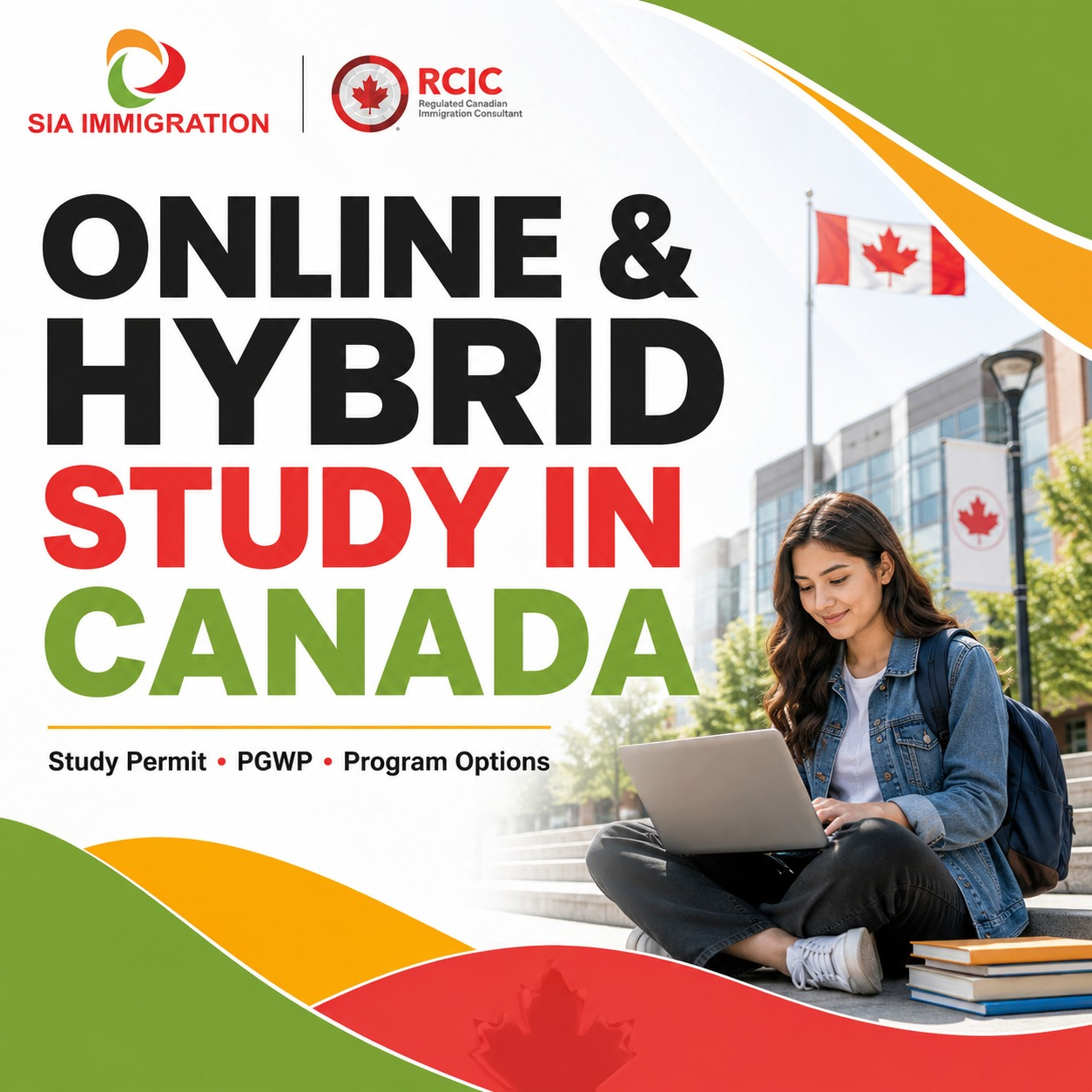
Online & Hybrid Study in Canada: What International Students Need to Know
Canada continues to attract international students who want quality education while maintaining flexibility in how and where they study. Online and hybrid programs can offer that flexibility, but the way a program is delivered can affect study-permit planning, Post-Graduation Work Permit (PGWP) eligibility and other immigration considerations.
Choosing a program simply because it offers online or hybrid classes is not enough. The school, specific program, delivery format, duration, location of in-person study and immigration requirements should all be reviewed before making a decision.
What Are Online and Hybrid Programs?
Online Program
Delivered primarily or entirely through online learning. Distance learning can be useful for flexibility, but it does not automatically create eligibility for a Canadian study permit or a PGWP.
Hybrid Program
Combines online learning with in-person classes, labs, practical training or other required activities at a campus or other location.
Traditional Program
Involves in-person study in Canada. However, attending classes in person does not by itself make a program PGWP eligible; the institution and specific program must meet the applicable requirements.
Online vs. Hybrid vs. In-Person Study
| Format | Immigration consideration |
|---|---|
| Online | IRCC states that completing a distance-learning program generally does not require a study permit. For PGWP purposes, the distance-learning rules are important, and time spent studying online from outside Canada after August 31, 2024 does not count toward PGWP length. |
| Hybrid | For students subject to the current distance-learning rules, at least 50% of the program must be completed in class within Canada. The exact rule that applies depends on the student's PGWP lock-in date. |
| In person | In-person attendance can satisfy the location component of the PGWP rules, but the program must still be at a PGWP-eligible DLI and meet the other applicable requirements. |
How Online and Hybrid Study Can Affect PGWP Eligibility
PGWP eligibility is not automatic. IRCC assesses general requirements, requirements based on the study program and requirements based on the student's physical location during study.
Sept. 1, 2024 or later
At least 50% of the program must be completed in class within Canada. Time spent studying outside Canada is deducted from the length of the PGWP. Online study from outside Canada after August 31, 2024 does not count toward PGWP length.
Sept. 1, 2022–Aug. 31, 2024
At least 50% of the program must be completed within Canada, either online or in class. Eligible online study from outside Canada before August 31, 2024 can count toward PGWP length if it represents less than 50% of the program.
IRCC says to look at the date you started your program and the date on your study-permit application receipt. Whichever date comes first is the lock-in date used for the distance-learning rules.
Other key PGWP requirements
- You generally need to complete a program of study at a PGWP-eligible DLI that is at least 8 months long, or 900 hours for applicable Quebec programs.
- You generally need to maintain full-time student status in Canada during each semester, although part-time study may be permitted in the final semester.
- You generally must apply for the PGWP within 180 days after confirmation that you completed your program.
- Not every program offered by a DLI is PGWP eligible. The specific program should be checked.
- Students who complete more than 50% of their program through distance learning are generally not eligible for a PGWP, subject to applicable exceptions.
Do Field-of-Study Requirements Apply?
Field-of-study requirements apply to certain PGWP applicants, but they do not apply to every program type.
Bachelor's, Master's & Doctoral
Graduates of bachelor's, master's and doctoral degree programs do not have a PGWP field-of-study requirement under the current rules.
Non-degree University Programs
If the study-permit application was submitted on or after November 1, 2024, an eligible field of study is required for the applicable PGWP rules.
Certificates & Diplomas
If the study-permit application was submitted on or after November 1, 2024, the graduate must generally have completed an eligible field of study.
Choosing a Program in British Columbia, Alberta or Ontario
Students may find online and hybrid options in British Columbia, Alberta, Ontario and other provinces. The best option is not necessarily the program with the highest percentage of online learning.
Compare these factors before choosing:
Healthcare, Education & Skilled Trades
Students may explore programs in healthcare, education and skilled trades. These should be viewed as career-focused areas, not as guarantees of immigration or permanent residence outcomes.
Healthcare
Healthcare-related programs can suit students interested in health services and related careers. The exact credential, program and applicable immigration rules should be assessed.
Education
Education and early-childhood-related programs may suit students interested in teaching, childcare and educational support roles.
Skilled Trades
Trades and technical programs can provide practical training in areas such as construction, automotive, electrical and other technical occupations.
Bachelor's and Master's Programs
Bachelor's and master's programs can be attractive options for international students seeking university-level education in Canada.
A partly or fully online program is therefore not automatically a better immigration option simply because it is more flexible.
What About Students Already in Canada?
Students already in Canada may have different circumstances from applicants applying from outside Canada.
Before changing schools, programs or study arrangements, review your current status and study-permit conditions and determine whether additional immigration steps are required.
IRCC also requires students to follow the conditions of their study permit and provides specific instructions for changing schools at the post-secondary level. A change made simply to obtain more online flexibility can have consequences for future eligibility.
Study Permit Considerations
Most international students who need a study permit must have a letter of acceptance from a designated learning institution. A provincial or territorial attestation letter (PAL/TAL) is required in many cases, but there are important exemptions.
Students should also understand that a study permit application involves more than receiving an admission offer. IRCC assesses factors such as enrolment at a DLI, financial capacity, admissibility and whether the applicant satisfies the requirements of the study-permit process.
Can Your Spouse or Common-Law Partner Get an Open Work Permit?
Spousal open work permit eligibility is not automatic because an international student is enrolled in an online or hybrid program.
Under current IRCC rules, starting January 21, 2025, the spouse or common-law partner of a student with a valid study permit may be eligible if the student is, for example:
- Studying in a master's degree program of 16 months or longer;
- Studying in a doctoral degree program;
- Participating in an IRCC-specified eligible program; or
- Studying in one of the specified professional university degree programs, including medicine, dentistry, law, pharmacy, veterinary medicine, nursing, education and engineering.
The eligible-program list is specific and includes certain programs and provincial initiatives. Students should verify the current IRCC list rather than assuming that a healthcare, education or trades program qualifies.
Online Learning Should Not Be the Main Reason for Choosing a Program
Flexibility is valuable, but online delivery should not be the only factor when selecting a Canadian program.
- Does the program match my previous education?
- Does it support my career goals?
- Is the institution a DLI?
- Is the specific program currently PGWP eligible?
- How much of the program is online?
- How much must be completed in class in Canada?
- Does a field-of-study requirement apply to my situation?
- Does the program fit my financial situation?
- Does it make sense for my long-term study and career plans?
Choose Your Program Based on Your Goals
There is no single Canadian study program that is right for every international student. A program that works well for one student may not be suitable for another because of differences in education, career objectives, finances, immigration history and long-term plans.
The right program should fit your overall circumstances — not simply offer the most flexible schedule.
How SIA Immigration Can Help
Choosing a Canadian study program involves more than comparing tuition fees and course schedules.
SIA Immigration can help students review immigration considerations associated with their proposed study plans, including:
Plan Your Canadian Study Journey Carefully
Online and hybrid programs can provide flexibility, but students need to understand how their study format interacts with Canada's immigration rules.
Study permits, distance-learning rules, PGWP eligibility, field-of-study requirements and spousal work permit rules can change. Verify the current requirements before making a decision.
The information in this article was checked against current IRCC pages in September 2026. These official pages should be reviewed again before an application is submitted.
Immigration rules, policies and program eligibility requirements can change. This article is provided for general informational purposes only and should not be considered legal or immigration advice. For the latest requirements, consult the official Government of Canada sources or seek professional immigration advice.