
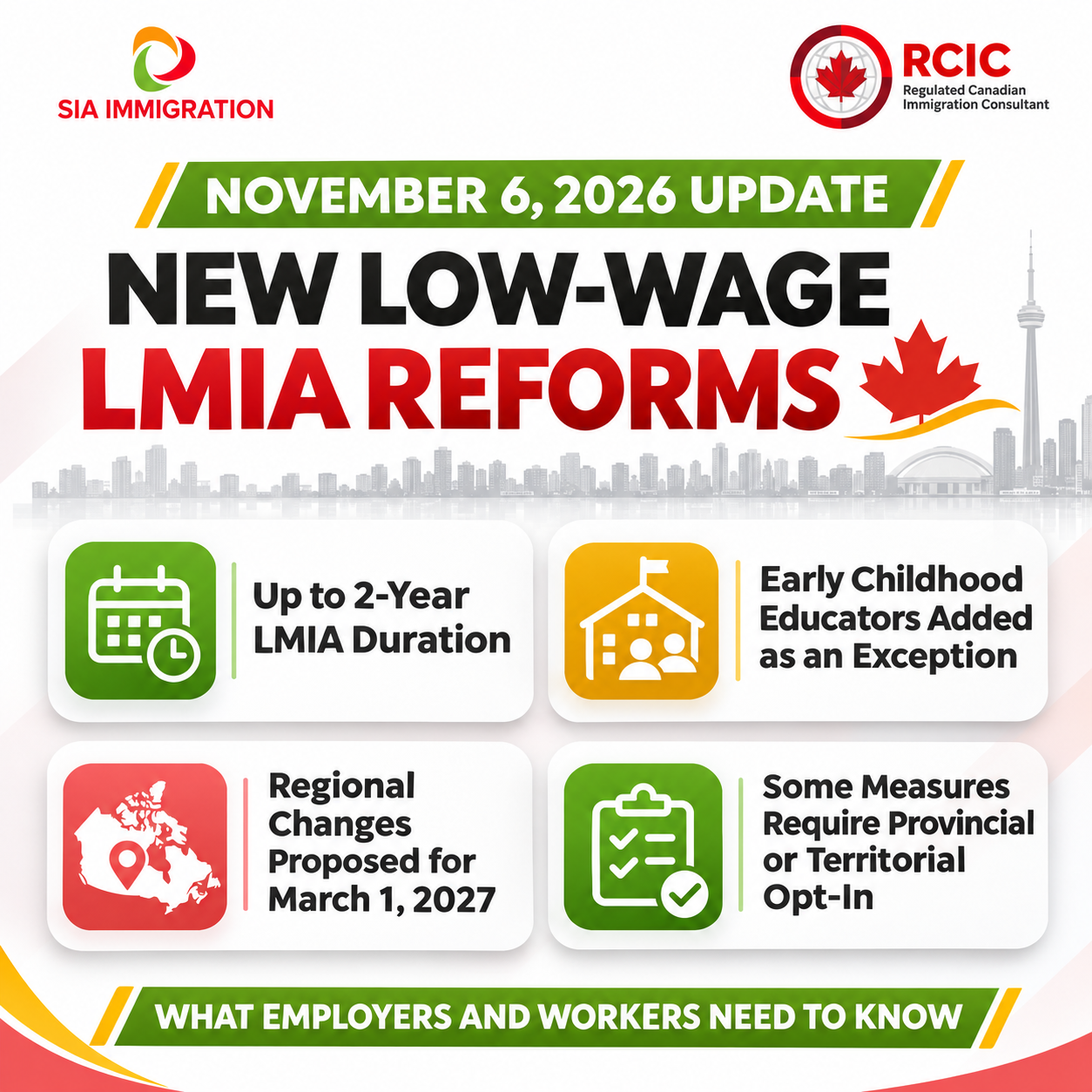






Canada announced targeted reforms to the Temporary Foreign Worker Program on November 6, 2026. Some low-wage LMIA changes are effective immediately, while additional regional measures are proposed for March 1, 2027 and will depend on provincial or territorial participation.
The reforms affect LMIA duration, early childhood educators, regional access to low-wage workers and potential workforce-cap flexibility. Not every measure starts at the same time.
Low-wage Stream LMIA applications submitted on or after November 6, 2026 may receive a maximum employment duration of up to two years, increased from one year.
Early childhood educators have been added to the priority-sector exceptions for low-wage LMIA processing in Census Metropolitan Areas with unemployment rates of 6% or higher.
Healthcare, construction and food processing were already identified priority sectors.
These changes are proposed and depend on provinces and territories opting in. Regional occupation access and the possible 15% cap will vary according to participation and local decisions.
Low-wage applications would continue not to be processed, except for identified priority sectors.
Access would be targeted to occupations identified through the Canadian Occupational Projection System and occupations added by participating provinces or territories.
Employers would receive targeted access based on projected labour needs and provincial or territorial additions. Occupations could also be removed locally.
Employers would continue to have access to all occupations under the Low-Wage Stream.
The LMIA process supports an employer’s request to hire a temporary foreign worker. A worker generally still needs the required work authorization. Permanent residence pathways have their own eligibility and selection requirements.
Our team can help employers and foreign workers understand the applicable LMIA stream, work-location rules, workforce caps, recruitment obligations and related work permit requirements.
Official source: Employment and Social Development Canada, November 6, 2026.
This article provides general information only and does not constitute legal or immigration advice. LMIA and work permit eligibility depends on the employer, occupation, work location, wage, worker and current government requirements.
Meet our team in Surrey or Kamloops. Choose the office most convenient for you.